First determine what authority may have been granted
Technical chapter
First determine what authority may have been granted
Deep technical lesson
01
Mental model
After a suspicious signature, start by identifying the signed payload, active approvals, connected sessions and whether assets have moved. Do not immediately destroy evidence or sign more messages from the possibly compromised context.
This concept matters because Preserve the suspicious payload and transaction hashes.
Triage determines what authority may exist and whether losses are ongoing before remediation changes the scene.
02
What actually happens
Preserve URL, timestamp, signature, active approvals, sessions and asset movement evidence first.
At protocol and execution level, inspect detect and scope and contain and preserve and prioritize. Protocol identifiers remain untranslated because they are part of the technical payload.
detect
identify suspicious event
scope
what accounts/sessions/approvals affected
contain
stop further authority
preserve
retain evidence
prioritize
assets at immediate risk first
03
Failure surface
Panic signing, revoking from the same compromised device or deleting sessions can destroy useful evidence or deepen compromise.
The practical consequence is that Check approvals and sessions before assuming the incident is over. Unknown is not equivalent to safe.
panic transactions
evidence deleted
wallet remains connected
active approvals unknown
compromised device reused
04
Decision standard
Stabilize, preserve evidence and move response to a known-clean environment.
The practical consequence is that Check approvals and sessions before assuming the incident is over.
Escalate when evidence is contradictory, incomplete or the consequence exceeds routine policy.
05
Verification procedure
Verify the request through independent evidence before irreversible authorization.
01
freeze risky activity
02
capture transaction/signature evidence
03
disconnect sessions
04
enumerate approvals/assets
05
choose containment actions by exposure
06
Required analyst output
Record the facts, assumptions, unknowns and decision so another analyst can reproduce the review.
Preserve the suspicious payload and transaction hashes. and Use a known-clean environment for remediation where possible.
Required analyst outputincident triage worksheet
LESSON VISUALFirst determine what authority may have been grantedincident triage
incident / triage
REAL-WORLD CONTEXT · INCIDENT RESPONSE ENVIRONMENTFirst determine what authority may have been grantedCONCEPT → REAL ENVIRONMENT → OPERATIONAL DECISION
VISUAL MODEL / POLICY MATRIXincident-triage
CONCEPT → EVIDENCE → FAILURE MODE → VERIFICATION
Technical workbook
Analyst objective
Preserve the suspicious payload and transaction hashes.
Mechanics
detectidentify suspicious event
scopewhat accounts/sessions/approvals affected
containstop further authority
preserveretain evidence
prioritizeassets at immediate risk first
Failure signals
01
panic transactions
02
evidence deleted
03
wallet remains connected
04
active approvals unknown
05
compromised device reused
Verification procedure
01
freeze risky activity
02
capture transaction/signature evidence
03
disconnect sessions
04
enumerate approvals/assets
05
choose containment actions by exposure
Reasoning chain
01
facts → material evidence
02
evidence → consequence / authority
03
consequence → explicit decision + next action
Required deliverableincident triage worksheet
Protocol walkthrough
Follow the security decision path
incident / triage
01Observe
detect: identify suspicious event
scope: what accounts/sessions/approvals affected
02Trace
contain: stop further authority
preserve: retain evidence
prioritize: assets at immediate risk first
03Challenge
panic transactions
evidence deleted
wallet remains connected
04Verify
freeze risky activity
capture transaction/signature evidence
disconnect sessions
05Output
incident triage worksheet
Authority surfacedetect · scope · contain
Failure conditionpanic transactions
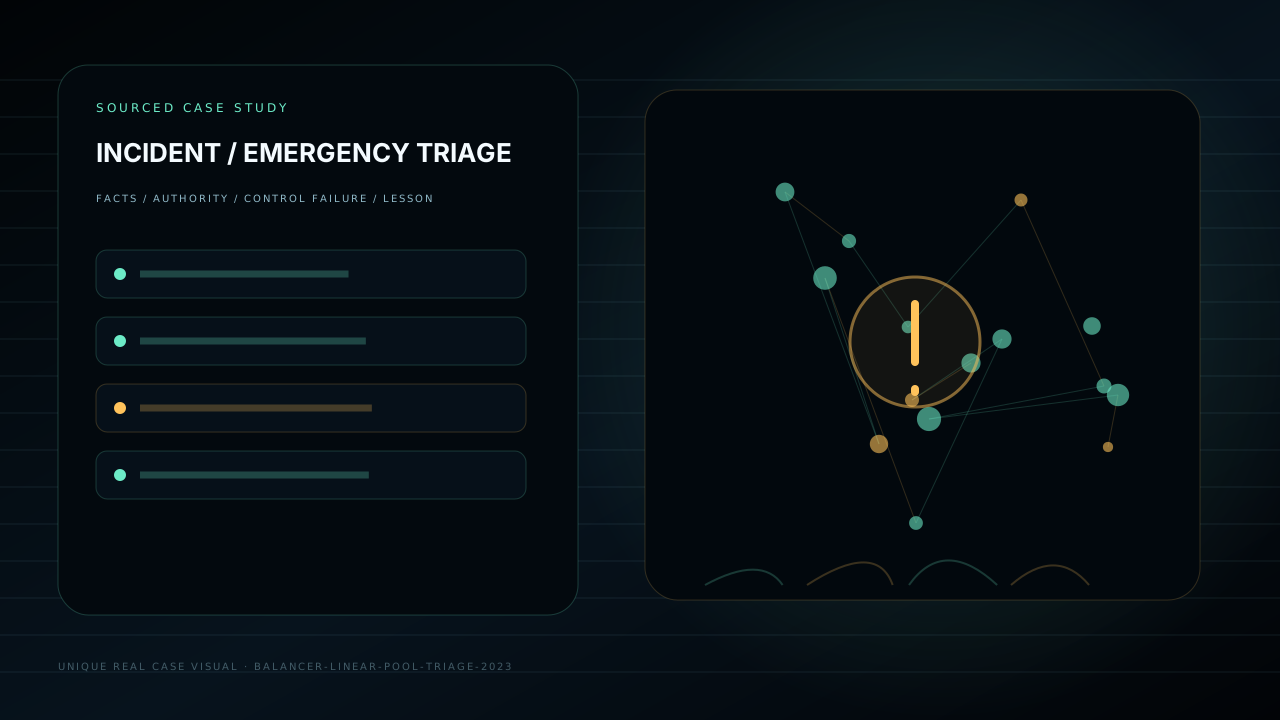
DOCUMENTED CASE STUDY · 2023-08-22Balancer linear-pool vulnerability triage
Documented case study
Balancer linear-pool vulnerability triage
On 22 August 2023 Balancer disclosed a critical vulnerability affecting some pools. Its Emergency SubDAO had mitigated more than 80% of affected liquidity, enabled proportional exits and urged users in remaining at-risk pools to withdraw.
Verified facts
findingcritical vulnerability in selected pools
mitigationmore than 80% of affected liquidity
emergency actionpause + proportional exit
remaining exposureapproximately 4% of Balancer TVL at disclosure
Operational lesson
Incident response starts before exploitation when credible evidence exists. Asset classification, emergency authority, user-specific exposure and a safe exit path materially change the blast radius.
Analyst question
What evidence threshold should trigger emergency controls, and how would you separate mitigated, pausable and still-at-risk assets in the first response hour?
Before answering the checkpoint, identify the authority being granted, the trust boundary that can fail, and the consequence that becomes irreversible.
Evidence map
Organize before you decide
Separate identity, authority, execution and context before reaching a security decision.
01
Identity
Who or what is requesting, receiving or representing authority?
wallet Connectedyes
02
Authority
What capability can be granted, retained or exercised?
approvalsnot enumerated
03
Execution
What will the payload, route or system actually do?
—
04
Context
Which surrounding facts can materially change the decision?
eventunexpected Permit2 signature
assets Movedunknown
device Compromisepossible
evidenceURL + timestamp + signature available
Field exercise
Produce an analyst-ready finding
Local-only analyst record
Do not answer from memory. Use the case, protocol fields and verification procedure above to write a reproducible finding.
Focusdetect · scope · contain
Failure signalpanic transactions
Verify firstfreeze risky activity
Deliverableincident triage worksheet
Completion criteria
Cites material evidence, not UI appearance.
Names the authority, state transition or consequence.
Provides a reproducible next action or decision.
Security notes
01
Preserve the suspicious payload and transaction hashes.
02
Check approvals and sessions before assuming the incident is over.
03
Use a known-clean environment for remediation where possible.
Analyst notebook
Build your evidence memo
Local-only learning record
Record your reasoning before the checkpoint. Finish with an explicit decision or next action. Notes stay on this device.
LOCAL STORAGE
×
Field exercise
Develop all three sections before completion.
Triage suspicious signatures and sessions before panic causes more damage or evidence is lost.