
← Back to Academy
LEVEL 5 · Professional
Web3 Security Professional
Combine incident response, treasury controls, threat modelling and integration design in a full security workflow.
8 lessons · 8 Field exercise · 8 Practical scenarios · 1 PROFESSIONAL CAPSTONE · 20 question · 80% passing score
Start learning0% · 0/22
Professional track. The curriculum is visible; commercial access control can be connected to UTXO billing without changing the course engine.
What you will be able to do
✓
Triage suspicious signatures and sessions before panic causes more damage or evidence is lost.
✓
Design high-value operations so one compromised browser, operator or wallet cannot independently move everything.
✓
Identify trust boundaries across browser, RPC, wallet, routers and external protocols before adding controls.
✓
Combine every layer of evidence into a documented allow, warn, block or review decision.
Curriculum
▸1.1 · First determine what authority may have been granted30 min
▸1.2 · Containment and evidence need to happen together28 min
Lab · Triage the incident
This course includes
- ·8 lessons · 24 guided hours
- ·4 Lab · Practical scenarios
- ·8 Applied case files · 8 Knowledge checks
- ·52 Item exam bank · 80% pass mark
- ·Completion credential: UTXO Certified · Web3 Security Professional
What this course expects of you
- ·Produce a defensible security decision from incomplete evidence.
- ·Passing score: 80%
- ·Advanced Transaction Security
Course briefing
Training contract
Produce a defensible security decision from incomplete evidence.
Practical deliverables
Incident response for wallets
Triage suspicious signatures and sessions before panic causes more damage or evidence is lost.
Evidence memo · INCIDENTTreasury separation & authorization
Design high-value operations so one compromised browser, operator or wallet cannot independently move everything.
Evidence memo · POLICYThreat modelling wallet integrations
Identify trust boundaries across browser, RPC, wallet, routers and external protocols before adding controls.
Evidence memo · THREAT-MODELCapstone: transaction security review
Combine every layer of evidence into a documented allow, warn, block or review decision.
Evidence memo · CAPSTONEAssessment contract
Lesson checks8
Module labs4
Final exam20
Mastery threshold80%
Complete syllabus
Web3 Security Professional
Review the full curriculum, competencies and assessment path before starting.
Guided study load24h
modules4
lessons8
01
Incident response for wallets
Triage suspicious signatures and sessions before panic causes more damage or evidence is lost.
1.1
First determine what authority may have been granted45 min · Deep technical lesson
1.2
Containment and evidence need to happen together45 min · Deep technical lesson
Module practical labTriage the incident
02
Treasury separation & authorization
Design high-value operations so one compromised browser, operator or wallet cannot independently move everything.
2.1
Separate holdings by purpose and blast radius45 min · Deep technical lesson
2.2
High-value authorization is a system, not a person45 min · Deep technical lesson
Module practical labApply treasury policy
03
Threat modelling wallet integrations
Identify trust boundaries across browser, RPC, wallet, routers and external protocols before adding controls.
3.1
Map trust boundaries before selecting controls45 min · Deep technical lesson
3.2
Security integrations should fail predictably45 min · Deep technical lesson
Module practical labMap the trust boundaries
04
Capstone: transaction security review
Combine every layer of evidence into a documented allow, warn, block or review decision.
4.1
Complex cases require evidence synthesis45 min · Deep technical lesson
4.2
No single detector should be your security boundary45 min · Deep technical lesson
Module practical labMake the final security decision
- Preserve the suspicious payload and transaction hashes.
- Check approvals and sessions before assuming the incident is over.
- Prioritize stopping active loss while preserving key evidence.
- Do not rely on screenshots alone when raw hashes and payloads exist.
- Separate hot operations from reserves.
- Keep only necessary balances exposed to DeFi permissions.
- Require independent authority for critical actions.
- Make policy state observable and auditable.
- List assets and authority before threats.
- Model compromised dependencies, not only malicious users.
- Define degraded modes explicitly.
- Distinguish unavailable evidence from safe evidence.
- Written field exercise × 8
- Knowledge checks × 8
- Module practical lab × 4
- Timed final exam · 20 · ≥ 80%
- Capstone · 90 min
- Deep technical lesson · 360 min
- Written field exercise · 160 min
- Module practical lab · 140 min
- Specialist units · 105 min
- Timed final exam · 45 min
- Capstone · 90 min
COURSE HANDBOOK
24hScope, outcomes and study standard
Combine incident response, treasury controls, threat modelling and integration design in a full security workflow.
Recommended prior study
- Understand What You Sign
- Advanced Transaction Security
- Preserve the suspicious payload and transaction hashes.
- Check approvals and sessions before assuming the incident is over.
- Use a known-clean environment for remediation where possible.
- Prioritize stopping active loss while preserving key evidence.
- Do not rely on screenshots alone when raw hashes and payloads exist.
- Document every remediation action.
- Separate hot operations from reserves.
- Keep only necessary balances exposed to DeFi permissions.
- Design transfer paths between tiers deliberately.
- Require independent authority for critical actions.
- 01
Read the six-part technical chapter
- 02
Inspect the unique visual and protocol model
- 03
Work through the case file and evidence map
- 04
Submit the written field exercise
- 05
Pass the knowledge check and module lab
- 06
Complete the timed final assessment
Claims should be tied to observable fields, protocol behavior, primary references or clearly stated assumptions. Unknowns must remain explicit instead of being silently treated as safe.
Completion requires the written work, knowledge checks, all module labs and a final exam score of at least 80%. Professional level also requires the capstone.
- First determine what authority may have been granted
- After a suspicious signature, start by identifying the signed payload, active approvals, connected sessions and whether assets have moved. Do not immediately destroy evidence or sign more messages from the possibly compromised context.
- Containment and evidence need to happen together
- Revoking approvals, disconnecting sessions and moving assets may be necessary, but remediation actions can also erase useful context. Record addresses, timestamps, domains, signatures and device indicators so the root cause can be understood later.
- Separate holdings by purpose and blast radius
- Treasury design should avoid one wallet holding operational liquidity, long-term reserves and every approval. Segmentation limits the maximum loss from a single compromised signer, browser session or protocol allowance.
- High-value authorization is a system, not a person
- Multisig, role separation, spend limits and destination allowlists reduce dependence on one operator. The goal is not bureaucracy; it is to ensure no single compromised component can silently satisfy every condition required to move critical value.
- Map trust boundaries before selecting controls
- A wallet-integrated application may trust browser code, RPC providers, routers, token contracts and wallet UX simultaneously. Threat modelling enumerates assets, actors, boundaries and abuse cases so controls address actual paths instead of generic fear.
- Security integrations should fail predictably
- A pre-execution security component must define what happens when simulation, reputation data or remote intelligence is unavailable. Silent allow-by-default can be dangerous, while unconditional blocking destroys usability. Failure policy should match transaction value and certainty.
- Complex cases require evidence synthesis
- Real incidents rarely present one perfect malicious indicator. Analysts combine origin age, approvals, proxy structure, simulation output, contract verification and user intent. Contradictions are not noise; they are often the most important signal.
- No single detector should be your security boundary
- Domain reputation, simulation, static decoding, policy and user confirmation each catch different failures. Defense in depth deliberately assumes that one layer can be wrong and still prevents a silent path to irreversible execution.
SPECIALIST EXTENSIONS
Modern protocol and operational topics
These extensions broaden the core curriculum with current standards and security boundaries that practitioners are expected to recognize.
EXT / 01
Threshold signing and distributed key authority
Threshold schemes distribute a signing primitive across parties without reconstructing one ordinary private key during normal operation. Security still depends on participant threshold, protocol implementation, share backup and correlated-compromise assumptions.
Security focussecret shares · threshold · DKG · signing rounds · correlated compromise
Study taskRead the primary material, identify the trust boundary, and explain how the mechanism changes the authorization or execution model.
Required outputProduce a concise analyst note containing assumptions, material evidence, failure conditions and a justified security decision.
Primary referencesNIST IR 8214C ↗
EXT / 02
Multisig governance beyond M-of-N
An M-of-N threshold is only one part of treasury security. Owner independence, modules, guards, payload review, role separation, signer replacement and change control determine whether multiple signatures are truly independent decisions.
Security focusowners · threshold · modules · guards · independent review · change control
Study taskRead the primary material, identify the trust boundary, and explain how the mechanism changes the authorization or execution model.
Required outputProduce a concise analyst note containing assumptions, material evidence, failure conditions and a justified security decision.
Primary referencesSafe Smart Account concepts ↗
EXT / 03
Key rotation, recovery and continuity drills
Key management is a lifecycle, not a one-time setup. Build rotation, replacement, emergency access and recovery drills that preserve control without creating an unmonitored bypass around ordinary authorization policy.
Security focusrotation · compromise response · recovery authority · continuity · tested runbooks
Study taskRead the primary material, identify the trust boundary, and explain how the mechanism changes the authorization or execution model.
Required outputProduce a concise analyst note containing assumptions, material evidence, failure conditions and a justified security decision.
Module 01
Incident response for wallets
Triage suspicious signatures and sessions before panic causes more damage or evidence is lost.
Lesson 1.1
First determine what authority may have been granted
Technical chapter
Deep technical lessonFirst determine what authority may have been granted
01
Mental model
After a suspicious signature, start by identifying the signed payload, active approvals, connected sessions and whether assets have moved. Do not immediately destroy evidence or sign more messages from the possibly compromised context.
This concept matters because Preserve the suspicious payload and transaction hashes.
Triage determines what authority may exist and whether losses are ongoing before remediation changes the scene.
02
What actually happens
Preserve URL, timestamp, signature, active approvals, sessions and asset movement evidence first.
At protocol and execution level, inspect detect and scope and contain and preserve and prioritize. Protocol identifiers remain untranslated because they are part of the technical payload.
detectidentify suspicious event
scopewhat accounts/sessions/approvals affected
containstop further authority
preserveretain evidence
prioritizeassets at immediate risk first
03
Failure surface
Panic signing, revoking from the same compromised device or deleting sessions can destroy useful evidence or deepen compromise.
The practical consequence is that Check approvals and sessions before assuming the incident is over. Unknown is not equivalent to safe.
- panic transactions
- evidence deleted
- wallet remains connected
- active approvals unknown
- compromised device reused
04
Decision standard
Stabilize, preserve evidence and move response to a known-clean environment.
The practical consequence is that Check approvals and sessions before assuming the incident is over.
Escalate when evidence is contradictory, incomplete or the consequence exceeds routine policy.
05
Verification procedure
Verify the request through independent evidence before irreversible authorization.
- 01
freeze risky activity
- 02
capture transaction/signature evidence
- 03
disconnect sessions
- 04
enumerate approvals/assets
- 05
choose containment actions by exposure
06
Required analyst output
Record the facts, assumptions, unknowns and decision so another analyst can reproduce the review.
Preserve the suspicious payload and transaction hashes. and Use a known-clean environment for remediation where possible.
Required analyst outputincident triage worksheet
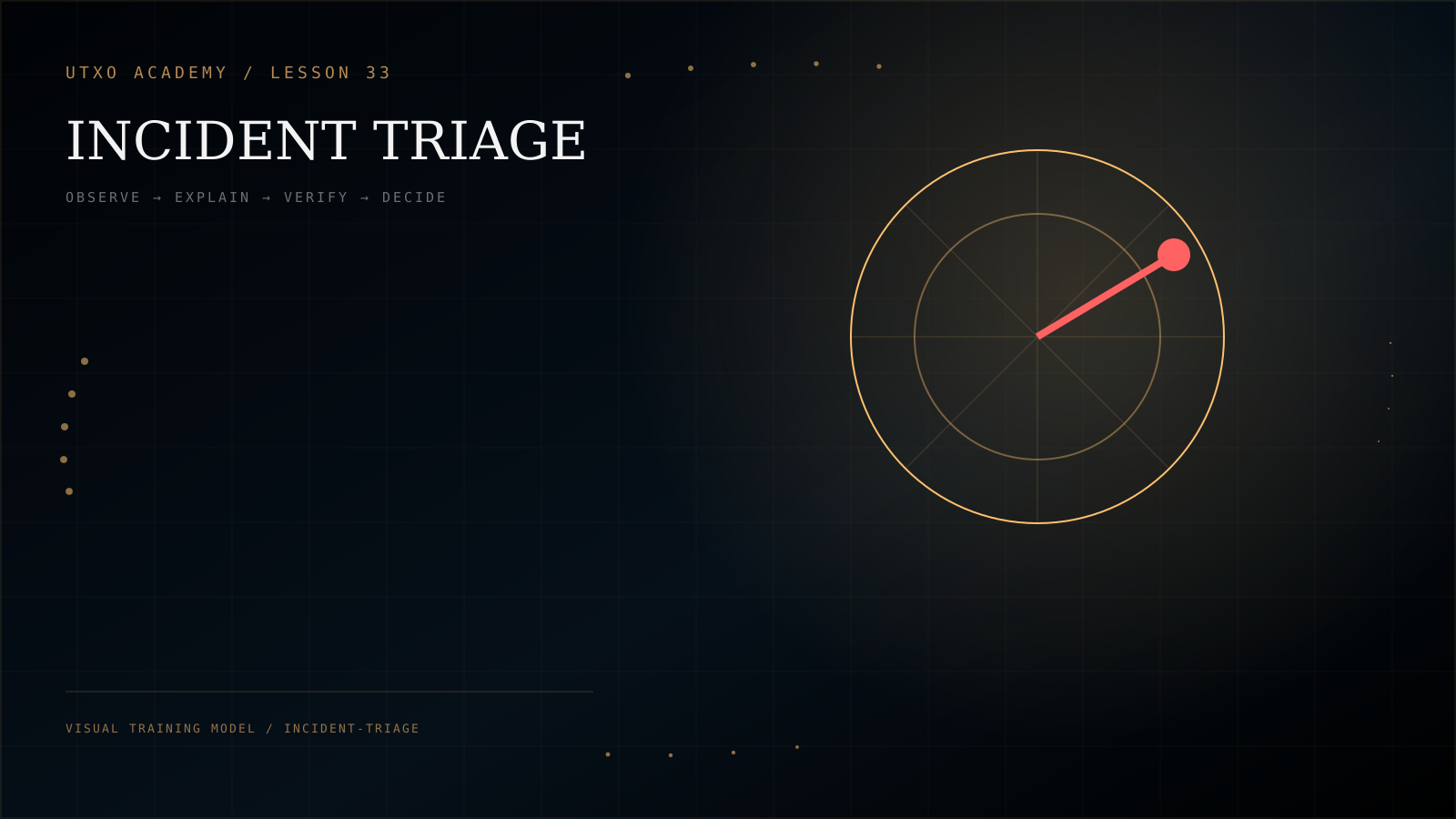
Technical workbook
Analyst objective
Preserve the suspicious payload and transaction hashes.
Mechanics
detect
identify suspicious eventscope
what accounts/sessions/approvals affectedcontain
stop further authoritypreserve
retain evidenceprioritize
assets at immediate risk firstFailure signals
- 01
panic transactions
- 02
evidence deleted
- 03
wallet remains connected
- 04
active approvals unknown
- 05
compromised device reused
Verification procedure
- 01
freeze risky activity
- 02
capture transaction/signature evidence
- 03
disconnect sessions
- 04
enumerate approvals/assets
- 05
choose containment actions by exposure
Reasoning chain
- 01
facts → material evidence
- 02
evidence → consequence / authority
- 03
consequence → explicit decision + next action
Required deliverable
incident triage worksheetProtocol walkthrough
Follow the security decision path
incident / triage01Observe
- detect: identify suspicious event
- scope: what accounts/sessions/approvals affected
02Trace
- contain: stop further authority
- preserve: retain evidence
- prioritize: assets at immediate risk first
03Challenge
- panic transactions
- evidence deleted
- wallet remains connected
04Verify
- freeze risky activity
- capture transaction/signature evidence
- disconnect sessions
05Output
- incident triage worksheet
Authority surfacedetect · scope · contain
Failure conditionpanic transactions
Documented case study
Balancer linear-pool vulnerability triage
On 22 August 2023 Balancer disclosed a critical vulnerability affecting some pools. Its Emergency SubDAO had mitigated more than 80% of affected liquidity, enabled proportional exits and urged users in remaining at-risk pools to withdraw.
Verified facts
finding
critical vulnerability in selected poolsmitigation
more than 80% of affected liquidityemergency action
pause + proportional exitremaining exposure
approximately 4% of Balancer TVL at disclosureOperational lesson
Incident response starts before exploitation when credible evidence exists. Asset classification, emergency authority, user-specific exposure and a safe exit path materially change the blast radius.
Analyst question
Primary sourceBalancer — Vulnerability found in some pools ↗What evidence threshold should trigger emergency controls, and how would you separate mitigated, pausable and still-at-risk assets in the first response hour?
Applied case file
first-responseevent
unexpected Permit2 signatureassets Moved
unknownwallet Connected
yesdevice Compromise
possibleapprovals
not enumeratedevidence
URL + timestamp + signature availableAnalyst task
Before answering the checkpoint, identify the authority being granted, the trust boundary that can fail, and the consequence that becomes irreversible.
Evidence map
Organize before you decide
Separate identity, authority, execution and context before reaching a security decision.
01
Identity
Who or what is requesting, receiving or representing authority?
wallet Connected
yes02
Authority
What capability can be granted, retained or exercised?
approvals
not enumerated03
Execution
What will the payload, route or system actually do?
—
04
Context
Which surrounding facts can materially change the decision?
event
unexpected Permit2 signatureassets Moved
unknowndevice Compromise
possibleevidence
URL + timestamp + signature availableField exercise
Local-only analyst recordProduce an analyst-ready finding
Do not answer from memory. Use the case, protocol fields and verification procedure above to write a reproducible finding.
Focusdetect · scope · contain
Failure signalpanic transactions
Verify firstfreeze risky activity
Deliverableincident triage worksheet
Completion criteria
- Cites material evidence, not UI appearance.
- Names the authority, state transition or consequence.
- Provides a reproducible next action or decision.
Security notes
- 01
Preserve the suspicious payload and transaction hashes.
- 02
Check approvals and sessions before assuming the incident is over.
- 03
Use a known-clean environment for remediation where possible.
Analyst notebook
Local-only learning recordBuild your evidence memo
Record your reasoning before the checkpoint. Finish with an explicit decision or next action. Notes stay on this device.
LOCAL STORAGE
Field exercise
Develop all three sections before completion.
Lesson 1.2
Containment and evidence need to happen together
Technical chapter
Deep technical lessonContainment and evidence need to happen together
01
Mental model
Revoking approvals, disconnecting sessions and moving assets may be necessary, but remediation actions can also erase useful context. Record addresses, timestamps, domains, signatures and device indicators so the root cause can be understood later.
This concept matters because Prioritize stopping active loss while preserving key evidence.
Containment reduces ongoing authority while evidence collection maintains a reproducible incident timeline.
02
What actually happens
Separate active-loss controls from forensic preservation tasks.
At protocol and execution level, inspect session revoke and approval revoke and asset migration and forensics and communication. Protocol identifiers remain untranslated because they are part of the technical payload.
session revokeremove connected authority
approval revokeremove token spend authority
asset migrationmove to uncompromised keys
forensicspreserve logs/hash/timestamps
communicationcoordinate without leaking secrets
03
Failure surface
Aggressive cleanup without records prevents root-cause analysis; slow containment can allow further loss.
The practical consequence is that Do not rely on screenshots alone when raw hashes and payloads exist. Unknown is not equivalent to safe.
- revoke from compromised device without plan
- move assets before understanding attacker
- no evidence timestamps
- seed exposed during support
- containment actions conflict
04
Decision standard
Prioritize active loss prevention while logging every remediation step.
The practical consequence is that Do not rely on screenshots alone when raw hashes and payloads exist.
Escalate when evidence is contradictory, incomplete or the consequence exceeds routine policy.
05
Verification procedure
Verify the request through independent evidence before irreversible authorization.
- 01
preserve evidence first where safe
- 02
rank active authority
- 03
revoke sessions/approvals
- 04
migrate keys/assets if needed
- 05
record every containment action
06
Required analyst output
Record the facts, assumptions, unknowns and decision so another analyst can reproduce the review.
Prioritize stopping active loss while preserving key evidence. and Document every remediation action.
Required analyst outputcontainment timeline + evidence bundle
Technical workbook
Analyst objective
Prioritize stopping active loss while preserving key evidence.
Mechanics
session revoke
remove connected authorityapproval revoke
remove token spend authorityasset migration
move to uncompromised keysforensics
preserve logs/hash/timestampscommunication
coordinate without leaking secretsFailure signals
- 01
revoke from compromised device without plan
- 02
move assets before understanding attacker
- 03
no evidence timestamps
- 04
seed exposed during support
- 05
containment actions conflict
Verification procedure
- 01
preserve evidence first where safe
- 02
rank active authority
- 03
revoke sessions/approvals
- 04
migrate keys/assets if needed
- 05
record every containment action
Reasoning chain
- 01
facts → material evidence
- 02
evidence → consequence / authority
- 03
consequence → explicit decision + next action
Required deliverable
containment timeline + evidence bundleProtocol walkthrough
Follow the security decision path
containment / evidence01Observe
- session revoke: remove connected authority
- approval revoke: remove token spend authority
02Trace
- asset migration: move to uncompromised keys
- forensics: preserve logs/hash/timestamps
- communication: coordinate without leaking secrets
03Challenge
- revoke from compromised device without plan
- move assets before understanding attacker
- no evidence timestamps
04Verify
- preserve evidence first where safe
- rank active authority
- revoke sessions/approvals
05Output
- containment timeline + evidence bundle
Authority surfacesession revoke · approval revoke · asset migration
Failure conditionrevoke from compromised device without plan
Applied case file
containment-planactive Sessions
3suspicious Approval
yesassets At Risk
$74,000device
possibly compromisedlogs
availablesafe Secondary Device
availableAnalyst task
Before answering the checkpoint, identify the authority being granted, the trust boundary that can fail, and the consequence that becomes irreversible.
Evidence map
Organize before you decide
Separate identity, authority, execution and context before reaching a security decision.
01
Identity
Who or what is requesting, receiving or representing authority?
—
02
Authority
What capability can be granted, retained or exercised?
suspicious Approval
yes03
Execution
What will the payload, route or system actually do?
—
04
Context
Which surrounding facts can materially change the decision?
active Sessions
3assets At Risk
$74,000device
possibly compromisedlogs
availablesafe Secondary Device
availableField exercise
Local-only analyst recordProduce an analyst-ready finding
Do not answer from memory. Use the case, protocol fields and verification procedure above to write a reproducible finding.
Focussession revoke · approval revoke · asset migration
Failure signalrevoke from compromised device without plan
Verify firstpreserve evidence first where safe
Deliverablecontainment timeline + evidence bundle
Completion criteria
- Cites material evidence, not UI appearance.
- Names the authority, state transition or consequence.
- Provides a reproducible next action or decision.
Security notes
- 01
Prioritize stopping active loss while preserving key evidence.
- 02
Do not rely on screenshots alone when raw hashes and payloads exist.
- 03
Document every remediation action.
Analyst notebook
Local-only learning recordBuild your evidence memo
Record your reasoning before the checkpoint. Finish with an explicit decision or next action. Notes stay on this device.
LOCAL STORAGE
Field exercise
Develop all three sections before completion.
Practical lab locked
Pass both lesson knowledge checks in this module before attempting the practical lab.
Module 02
Treasury separation & authorization
Design high-value operations so one compromised browser, operator or wallet cannot independently move everything.

Module locked
Complete the previous module, including its practical lab, before continuing.
Module 03
Threat modelling wallet integrations
Identify trust boundaries across browser, RPC, wallet, routers and external protocols before adding controls.

Module locked
Complete the previous module, including its practical lab, before continuing.
Module 04
Capstone: transaction security review
Combine every layer of evidence into a documented allow, warn, block or review decision.
Module locked
Complete the previous module, including its practical lab, before continuing.
PROFESSIONAL CAPSTONE
This assessment combines origin integrity, typed-data authority, upgradeability, simulation evidence and treasury policy. Passing requires a reproducible evidence trail, not a guessed risk label.
FINAL EXERCISE · FORENSIC MACHINE
A treasury incident, and a machine to investigate it on.
Complete the modules and the capstone to open the forensic machine.
Final examination
Final examination
This is a cumulative assessment. Questions are rebuilt from the course concepts and practical scenarios on every attempt.
You must score at least 80% to pass. Completing theory alone does not issue a credential.
Passing score80%
Best score0%
Bank52
Attempt20
Attempts0
Time limit45 min
LOCKEDComplete every lesson checkpoint and every practical lab before the final examination unlocks.