
← Back to Academy
LEVEL 4 · Professional
Advanced Transaction Security
Study proxies, simulation limits, bridges and policy controls used in high-value transaction review.
8 lessons · 8 Field exercise · 8 Practical scenarios · 20 question · 80% passing score
Start learning0% · 0/21
Professional track. The curriculum is visible; commercial access control can be connected to UTXO billing without changing the course engine.
What you will be able to do
✓
Trace execution through upgradeable contracts and delegatecall instead of trusting the visible proxy address.
✓
Use simulation as evidence while understanding block-state, timing and conditional-execution divergence.
✓
Model the additional validators, relayers, bridges and wrapped-asset assumptions introduced by cross-chain execution.
✓
Turn security principles into deterministic controls for amounts, destinations, approvals and authorization paths.
Curriculum
▸1.1 · A proxy address is not the whole contract26 min
▸1.2 · Delegatecall executes foreign code in local state24 min
Lab · Resolve execution context
This course includes
- ·8 lessons · 20 guided hours
- ·4 Lab · Practical scenarios
- ·8 Applied case files · 8 Knowledge checks
- ·52 Item exam bank · 80% pass mark
- ·Completion credential: UTXO Certified · Advanced Transaction Security
What this course expects of you
- ·Review complex execution paths without trusting one signal.
- ·Passing score: 80%
- ·Understand What You Sign
Course briefing
Training contract
Review complex execution paths without trusting one signal.
Practical deliverables
Proxies & execution context
Trace execution through upgradeable contracts and delegatecall instead of trusting the visible proxy address.
Evidence memo · PROXYSimulation & its limits
Use simulation as evidence while understanding block-state, timing and conditional-execution divergence.
Evidence memo · SIMULATIONCross-chain trust & routing
Model the additional validators, relayers, bridges and wrapped-asset assumptions introduced by cross-chain execution.
Evidence memo · BRIDGETransaction policy controls
Turn security principles into deterministic controls for amounts, destinations, approvals and authorization paths.
Evidence memo · POLICYAssessment contract
Lesson checks8
Module labs4
Final exam20
Mastery threshold80%
Complete syllabus
Advanced Transaction Security
Review the full curriculum, competencies and assessment path before starting.
Guided study load20h
modules4
lessons8
01
Proxies & execution context
Trace execution through upgradeable contracts and delegatecall instead of trusting the visible proxy address.
1.1
A proxy address is not the whole contract45 min · Deep technical lesson
1.2
Delegatecall executes foreign code in local state45 min · Deep technical lesson
Module practical labResolve execution context
02
Simulation & its limits
Use simulation as evidence while understanding block-state, timing and conditional-execution divergence.
2.1
Simulation is a model of one possible execution45 min · Deep technical lesson
2.2
Execution can diverge from simulation45 min · Deep technical lesson
Module practical labChallenge the simulation
03
Cross-chain trust & routing
Model the additional validators, relayers, bridges and wrapped-asset assumptions introduced by cross-chain execution.
3.1
A bridge adds a new security system45 min · Deep technical lesson
3.2
More hops mean more independent failure modes45 min · Deep technical lesson
Module practical labReview the cross-chain route
04
Transaction policy controls
Turn security principles into deterministic controls for amounts, destinations, approvals and authorization paths.
4.1
Policies convert principles into enforceable conditions45 min · Deep technical lesson
4.2
Authorization should match consequence45 min · Deep technical lesson
Module practical labApply treasury policy
- Resolve the active implementation.
- Identify who can upgrade it.
- Trace delegatecall paths when reviewing critical execution.
- Storage layout and implementation code both matter.
- Record the state and assumptions used for simulation.
- Compare predicted asset changes with user intent.
- Ask what can change before execution.
- Watch for time, block and mutable-state conditions.
- Identify who attests to cross-chain events.
- Understand custody or mint/burn assumptions.
- Enumerate every contract and trust boundary in the route.
- Scope approvals to the route where possible.
- Written field exercise × 8
- Knowledge checks × 8
- Module practical lab × 4
- Timed final exam · 20 · ≥ 80%
- Deep technical lesson · 360 min
- Written field exercise · 160 min
- Module practical lab · 140 min
- Specialist units · 105 min
- Timed final exam · 40 min
COURSE HANDBOOK
20hScope, outcomes and study standard
Study proxies, simulation limits, bridges and policy controls used in high-value transaction review.
Recommended prior study
- Wallet Security & Self-Custody
- Understand What You Sign
- Resolve the active implementation.
- Identify who can upgrade it.
- Treat upgradeability as an ongoing trust assumption.
- Trace delegatecall paths when reviewing critical execution.
- Storage layout and implementation code both matter.
- Proxy safety cannot be inferred from address reputation alone.
- Record the state and assumptions used for simulation.
- Compare predicted asset changes with user intent.
- Simulation is evidence, not an oracle.
- Ask what can change before execution.
- 01
Read the six-part technical chapter
- 02
Inspect the unique visual and protocol model
- 03
Work through the case file and evidence map
- 04
Submit the written field exercise
- 05
Pass the knowledge check and module lab
- 06
Complete the timed final assessment
Claims should be tied to observable fields, protocol behavior, primary references or clearly stated assumptions. Unknowns must remain explicit instead of being silently treated as safe.
Completion requires the written work, knowledge checks, all module labs and a final exam score of at least 80%. Professional level also requires the capstone.
- A proxy address is not the whole contract
- Upgradeable proxy patterns store state at one address while delegating logic to an implementation that can change. Reviewing only the proxy's verified surface can miss the current implementation, upgrade authority or initialization risks.
- Delegatecall executes foreign code in local state
- Delegatecall runs another contract's code while preserving the caller's storage and execution context. This is powerful for proxies and modular systems but means the apparent callee and the actual code path can differ substantially.
- Simulation is a model of one possible execution
- Transaction simulation executes a candidate payload against a chosen state snapshot and environment. It is extremely useful for predicted balance and state changes, but its result is conditioned on the block state, RPC fidelity, external calls and environmental values used during simulation.
- Execution can diverge from simulation
- Contracts can branch on mutable storage, block values, external state or other conditions that change between simulation and inclusion. Adversarial code may deliberately exploit those differences. Independent static/context analysis therefore remains valuable even when simulation looks clean.
- A bridge adds a new security system
- Moving value across chains generally introduces validators, relayers, light-client logic, liquidity providers or wrapped representations. The destination asset may therefore depend on a security model that differs from both source and destination chains.
- More hops mean more independent failure modes
- A routed swap can traverse aggregators, DEXs, bridges and destination contracts. Each hop can be individually correct while the end-to-end path introduces slippage, approval, trust or availability risk. Review the route as a composed system.
- Policies convert principles into enforceable conditions
- A transaction policy can require review for new destinations, cap amounts, forbid unlimited approvals or demand a second approver. Good policies use deterministic facts and clear exceptions so operators know why an action was stopped.
- Authorization should match consequence
- Low-value routine actions and six-figure treasury transfers should not share identical approval paths. Risk-based controls can require independent review, allowlists, time delays or hardware signing based on amount, destination novelty and permission scope.
SPECIALIST EXTENSIONS
Modern protocol and operational topics
These extensions broaden the core curriculum with current standards and security boundaries that practitioners are expected to recognize.
EXT / 01
Wallet execution permissions and ERC-7715
Permission requests can authorize another account or session to act under explicit rules. Allowance, expiry, target and permitted behavior form a policy object whose scope must be understandable before consent.
Security focuspermission type · rules · expiry · allowance · delegated session authority
Study taskRead the primary material, identify the trust boundary, and explain how the mechanism changes the authorization or execution model.
Required outputProduce a concise analyst note containing assumptions, material evidence, failure conditions and a justified security decision.
Primary referencesERC-7715 ↗
EXT / 02
MEV, ordering and transaction exposure
Transaction safety also depends on where and when a valid request enters the ordering pipeline. Learn frontrunning, sandwich risk, private orderflow and how ordering can alter outcomes without changing the signed payload.
Security focusmempool exposure · ordering · frontrunning · sandwiching · private submission
Study taskRead the primary material, identify the trust boundary, and explain how the mechanism changes the authorization or execution model.
Required outputProduce a concise analyst note containing assumptions, material evidence, failure conditions and a justified security decision.
Primary referencesEthereum MEV docs ↗
EXT / 03
L2 sequencers, data availability and finality states
Rollups add sequencing, data publication and settlement states between intent and finality. Distinguish unsafe, safe and finalized states, sequencer outage/censorship assumptions and the actual data-availability layer.
Security focussequencer · unsafe/safe/finalized · data availability · forced inclusion · L1 settlement
Study taskRead the primary material, identify the trust boundary, and explain how the mechanism changes the authorization or execution model.
Required outputProduce a concise analyst note containing assumptions, material evidence, failure conditions and a justified security decision.
Module 01
Proxies & execution context
Trace execution through upgradeable contracts and delegatecall instead of trusting the visible proxy address.

Lesson 1.1
A proxy address is not the whole contract
Technical chapter
Deep technical lessonA proxy address is not the whole contract
01
Mental model
Upgradeable proxy patterns store state at one address while delegating logic to an implementation that can change. Reviewing only the proxy's verified surface can miss the current implementation, upgrade authority or initialization risks.
This concept matters because Resolve the active implementation.
A proxy preserves address/state while executable logic can change behind it.
02
What actually happens
Resolve current implementation, verification state, upgrade admin and timelock.
At protocol and execution level, inspect proxy and implementation and admin and storage and upgrade path. Protocol identifiers remain untranslated because they are part of the technical payload.
proxyuser-facing state address
implementationdelegated logic
adminupgrade authority
storageproxy state layout
upgrade pathlogic can change after review
03
Failure surface
A previously reviewed address can execute newly upgraded logic controlled by a single compromised admin.
The practical consequence is that Identify who can upgrade it. Unknown is not equivalent to safe.
- proxy verified / implementation unknown
- admin untrusted
- recent implementation change
- initialization ambiguity
- upgradeable spender
04
Decision standard
Treat implementation and upgrade authority as first-class evidence for critical calls.
The practical consequence is that Identify who can upgrade it.
Escalate when evidence is contradictory, incomplete or the consequence exceeds routine policy.
05
Verification procedure
Verify the request through independent evidence before irreversible authorization.
- 01
identify proxy pattern
- 02
read implementation slot / resolver
- 03
verify implementation code
- 04
identify admin / timelock
- 05
record upgradeability as ongoing trust
06
Required analyst output
Record the facts, assumptions, unknowns and decision so another analyst can reproduce the review.
Resolve the active implementation. and Treat upgradeability as an ongoing trust assumption.
Required analyst outputproxy trust-boundary map
Technical workbook
Analyst objective
Resolve the active implementation.
Mechanics
proxy
user-facing state addressimplementation
delegated logicadmin
upgrade authoritystorage
proxy state layoutupgrade path
logic can change after reviewFailure signals
- 01
proxy verified / implementation unknown
- 02
admin untrusted
- 03
recent implementation change
- 04
initialization ambiguity
- 05
upgradeable spender
Verification procedure
- 01
identify proxy pattern
- 02
read implementation slot / resolver
- 03
verify implementation code
- 04
identify admin / timelock
- 05
record upgradeability as ongoing trust
Reasoning chain
- 01
facts → material evidence
- 02
evidence → consequence / authority
- 03
consequence → explicit decision + next action
Required deliverable
proxy trust-boundary mapProtocol walkthrough
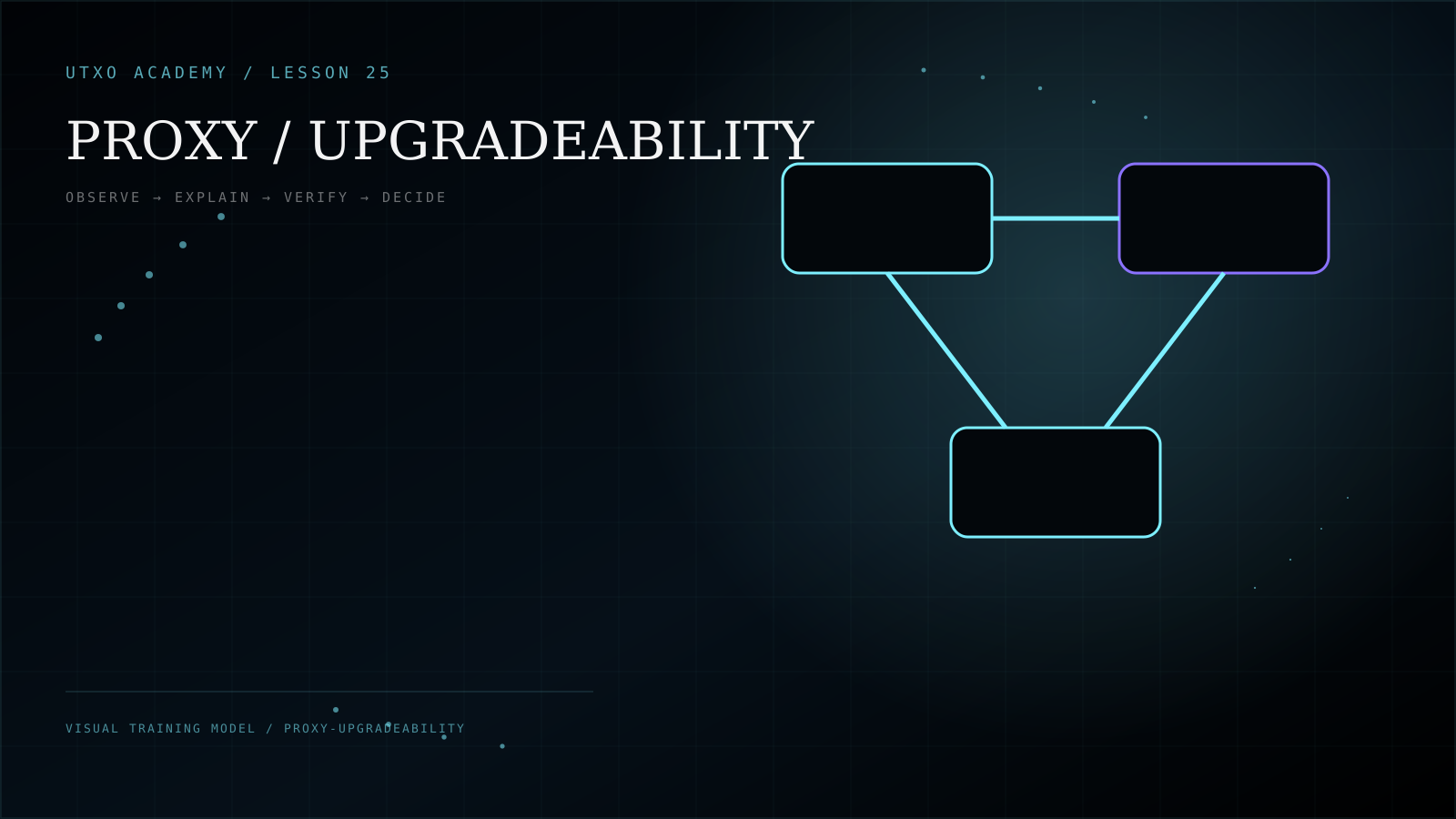
Follow the security decision path
proxy / upgradeability01Observe
- proxy: user-facing state address
- implementation: delegated logic
02Trace
- admin: upgrade authority
- storage: proxy state layout
- upgrade path: logic can change after review
03Challenge
- proxy verified / implementation unknown
- admin untrusted
- recent implementation change
04Verify
- identify proxy pattern
- read implementation slot / resolver
- verify implementation code
05Output
- proxy trust-boundary map
Authority surfaceproxy · implementation · admin
Failure conditionproxy verified / implementation unknown
Applied case file
proxy-reviewproxy
verifiedimplementation
0xImplV7implementation Verified
yesupgrade Admin
single EOAlast Upgrade
2 days agotimelock
noneAnalyst task
Before answering the checkpoint, identify the authority being granted, the trust boundary that can fail, and the consequence that becomes irreversible.
Evidence map
Organize before you decide
Separate identity, authority, execution and context before reaching a security decision.
01
Identity
Who or what is requesting, receiving or representing authority?
—
02
Authority
What capability can be granted, retained or exercised?
upgrade Admin
single EOA03
Execution
What will the payload, route or system actually do?
proxy
verifiedimplementation
0xImplV7implementation Verified
yes04
Context
Which surrounding facts can materially change the decision?
last Upgrade
2 days agotimelock
noneField exercise
Local-only analyst recordProduce an analyst-ready finding
Do not answer from memory. Use the case, protocol fields and verification procedure above to write a reproducible finding.
Focusproxy · implementation · admin
Failure signalproxy verified / implementation unknown
Verify firstidentify proxy pattern
Deliverableproxy trust-boundary map
Completion criteria
- Cites material evidence, not UI appearance.
- Names the authority, state transition or consequence.
- Provides a reproducible next action or decision.
Security notes
- 01
Resolve the active implementation.
- 02
Identify who can upgrade it.
- 03
Treat upgradeability as an ongoing trust assumption.
Analyst notebook
Local-only learning recordBuild your evidence memo
Record your reasoning before the checkpoint. Finish with an explicit decision or next action. Notes stay on this device.
LOCAL STORAGE
Field exercise
Develop all three sections before completion.
Lesson 1.2
Delegatecall executes foreign code in local state
Technical chapter
Deep technical lessonDelegatecall executes foreign code in local state
01
Mental model
Delegatecall runs another contract's code while preserving the caller's storage and execution context. This is powerful for proxies and modular systems but means the apparent callee and the actual code path can differ substantially.
This concept matters because Trace delegatecall paths when reviewing critical execution.
delegatecall runs external code in the caller's storage and execution context.
02
What actually happens
Trace every delegatecall target and determine whose storage is mutated.
At protocol and execution level, inspect opcode and code source and storage context and msg.sender / value and risk. Protocol identifiers remain untranslated because they are part of the technical payload.
opcodeDELEGATECALL
code sourcecallee implementation
storage contextcaller storage
msg.sender / valuepreserved call context
riskforeign code mutates local state
03
Failure surface
Reviewing only the entry contract misses the code that actually controls state changes.
The practical consequence is that Storage layout and implementation code both matter. Unknown is not equivalent to safe.
- unexpected delegatecall
- implementation not verified
- storage collision risk
- privileged method reachable
- dynamic implementation selection
04
Decision standard
Require verified implementation paths for high-impact delegatecall execution.
The practical consequence is that Storage layout and implementation code both matter.
Escalate when evidence is contradictory, incomplete or the consequence exceeds routine policy.
05
Verification procedure
Verify the request through independent evidence before irreversible authorization.
- 01
identify delegatecall edge
- 02
resolve callee code
- 03
map caller storage context
- 04
trace privileged effects
- 05
compare reachable authority to intent
06
Required analyst output
Record the facts, assumptions, unknowns and decision so another analyst can reproduce the review.
Trace delegatecall paths when reviewing critical execution. and Proxy safety cannot be inferred from address reputation alone.
Required analyst outputdelegatecall execution trace
Technical workbook
Analyst objective
Trace delegatecall paths when reviewing critical execution.
Mechanics
opcode
DELEGATECALLcode source
callee implementationstorage context
caller storagemsg.sender / value
preserved call contextrisk
foreign code mutates local stateFailure signals
- 01
unexpected delegatecall
- 02
implementation not verified
- 03
storage collision risk
- 04
privileged method reachable
- 05
dynamic implementation selection
Verification procedure
- 01
identify delegatecall edge
- 02
resolve callee code
- 03
map caller storage context
- 04
trace privileged effects
- 05
compare reachable authority to intent
Reasoning chain
- 01
facts → material evidence
- 02
evidence → consequence / authority
- 03
consequence → explicit decision + next action
Required deliverable
delegatecall execution traceProtocol walkthrough
Follow the security decision path
delegatecall / context01Observe
- opcode: DELEGATECALL
- code source: callee implementation
02Trace
- storage context: caller storage
- msg.sender / value: preserved call context
- risk: foreign code mutates local state
03Challenge
- unexpected delegatecall
- implementation not verified
- storage collision risk
04Verify
- identify delegatecall edge
- resolve callee code
- map caller storage context
05Output
- delegatecall execution trace
Authority surfaceopcode · code source · storage context
Failure conditionunexpected delegatecall
Applied case file
delegate-pathentry
proxymethod
execute(bytes)delegatecall
facet 0xF...storage
proxycaller
user walletfacet Verified
novalue
0 ETHAnalyst task
Before answering the checkpoint, identify the authority being granted, the trust boundary that can fail, and the consequence that becomes irreversible.
Evidence map
Organize before you decide
Separate identity, authority, execution and context before reaching a security decision.
01
Identity
Who or what is requesting, receiving or representing authority?
—
02
Authority
What capability can be granted, retained or exercised?
—
03
Execution
What will the payload, route or system actually do?
method
execute(bytes)delegatecall
facet 0xF...storage
proxycaller
user walletvalue
0 ETH04
Context
Which surrounding facts can materially change the decision?
entry
proxyfacet Verified
noField exercise
Local-only analyst recordProduce an analyst-ready finding
Do not answer from memory. Use the case, protocol fields and verification procedure above to write a reproducible finding.
Focusopcode · code source · storage context
Failure signalunexpected delegatecall
Verify firstidentify delegatecall edge
Deliverabledelegatecall execution trace
Completion criteria
- Cites material evidence, not UI appearance.
- Names the authority, state transition or consequence.
- Provides a reproducible next action or decision.
Security notes
- 01
Trace delegatecall paths when reviewing critical execution.
- 02
Storage layout and implementation code both matter.
- 03
Proxy safety cannot be inferred from address reputation alone.
Analyst notebook
Local-only learning recordBuild your evidence memo
Record your reasoning before the checkpoint. Finish with an explicit decision or next action. Notes stay on this device.
LOCAL STORAGE
Field exercise
Develop all three sections before completion.
Practical lab locked
Pass both lesson knowledge checks in this module before attempting the practical lab.
Module 02
Simulation & its limits
Use simulation as evidence while understanding block-state, timing and conditional-execution divergence.
Module locked
Complete the previous module, including its practical lab, before continuing.
Module 03
Cross-chain trust & routing
Model the additional validators, relayers, bridges and wrapped-asset assumptions introduced by cross-chain execution.

Module locked
Complete the previous module, including its practical lab, before continuing.
Module 04
Transaction policy controls
Turn security principles into deterministic controls for amounts, destinations, approvals and authorization paths.
Module locked
Complete the previous module, including its practical lab, before continuing.
Final examination
Final examination
This is a cumulative assessment. Questions are rebuilt from the course concepts and practical scenarios on every attempt.
You must score at least 80% to pass. Completing theory alone does not issue a credential.
Passing score80%
Best score0%
Bank52
Attempt20
Attempts0
Time limit40 min
LOCKEDComplete every lesson checkpoint and every practical lab before the final examination unlocks.